
 Emizentech
 Call
 hello@emizentech.ae


You need three senior React developers by next month, your internal team is already stretched across two live projects, and the recruitment process alone could take four to six months which you simply don’t have. This is the exact pressure point where businesses across the UAE are turning to staff augmentation instead of traditional hiring.
So if you are wondering what is staff augmentation exactly; it’s a flexible workforce model where you bring in external tech professionals who work directly under your management, without the overhead of permanent employment. The UAE Digital Economy Strategy aims to double the digital economy’s share of GDP from 9.7% to 19.4%, with a longer-term ambition of 30% by 2031. To keep pace with this rapid growth, businesses are aggressively scaling their technical infrastructure and using flexible staffing models like team augmentation to bridge the regional tech talent gap.
This guide covers everything from how team augmentation works and what it costs to how to choose the right partner.
What is Staff Augmentation?
Staff augmentation is when a company temporarily hires outside experts to join their internal team to help finish a project. Think of it like hiring a specialised freelancer, but instead of working completely on their own, they work directly with your existing team, and report to your managers.
Many different types of companies use this model to scale up their workforce quickly without the long-term commitment of hiring full-time employees.
Who Uses Staff Augmentation?
Almost any business can use staff augmentation, but it is most popular among companies that rely heavily on specialised project work, which is discussed further.
- Tech and IT Companies: agencies often need extra programmers, QA testers or cybersecurity experts to finish a significant tech project on time.
- Growing Startups: Small companies that have fluctuating workloads, and cannot afford to hire full-time as well as permanent employees yet.
- Large Enterprises: Huge corporations that need specialised skills for a short-term initiative such as, upgrading their entire internal database system without affecting their permanent workforce.
- Creative Agencies: Marketing, design and advertising firms that take on large client projects and need extra designers, or copywriters for a month or two.
- Healthcare & Finance Firms: These are highly regulated industries that rely on outside compliance, or data experts to help them verify that their platforms are compliant with strict laws without adding to their payroll permanently.
You should utilise staff augmentation services when your business face critical skill gaps, need to meet tight project deadlines or experience temporary workload spikes that your current team cannot handle alone. It is an ideal strategy when you want to retain complete management control over your day to day operations while scaling your workforce up or down quickly without the commitment of long term full hiring.
Additionally, this approach pairs perfectly with external startup consulting services which will allow growing companies to immediately inject specialised, hands-on technical or creative talent to execute the strategic roadmaps and growth plans laid out by their advisors.
Why Do Companies Use It?
- Speed: If your company needs a mobile app developer today, you can get one via staff augmentation in a few days rather than waiting months to recruit someone
- Flexibility: You can easily end the contract when a big project finishes, without having to lay off permanent staff
- Saving Money: You pay for the time you contract, either hourly or as a fixed monthly retainer, depending on your agreement since there are no full-time benefits, equipment costs or long-term training bills to cover
- Plugging Skill Gaps: If your team is great at building websites, but knows nothing about cybersecurity then you can bring in one cybersecurity expert to secure the site and then leave
How Does Staff Augmentation Work?
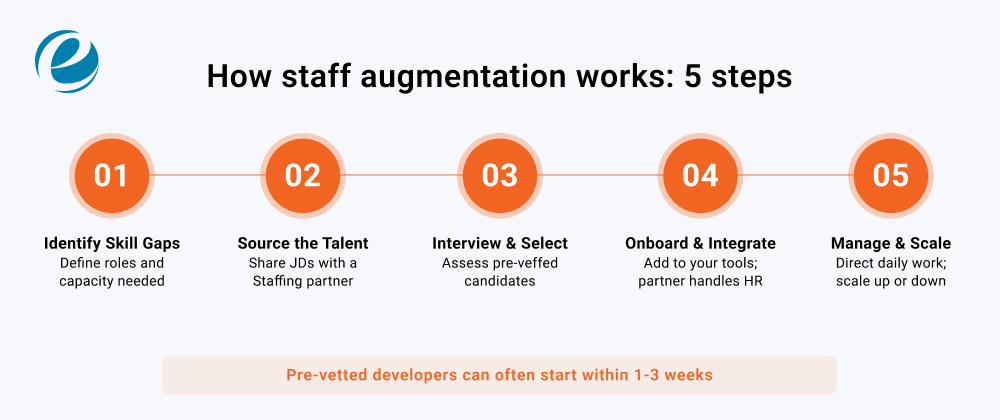
Staff augmentation allows you to add specialised external talent to your existing internal team on a temporary basis. You retain full control over the project and manage the augmented staff just like your internal employees.
Here is the step-by-step process of how staff augmentation works:
Step 1: Identify Skill Gaps
First, analyse your current team to determine exactly what skills or additional capacity you need to achieve your project goals. This is when companies often look into IT staff augmentation to find niche technical skills, like cloud architecture or cybersecurity, that their in-house team currently lacks.
Step 2: Source the Talent
Next, you share your job descriptions and project timelines, with a trusted staffing agency. Then, the service agency filters through their talent pool to find qualified professionals which will help you to hire dedicated developers or engineers without going through a complex recruitment process.
Step 3: Interview and Select
After that, the agency will further provide you with a shortlist of pre-vetted candidates, where you conduct the final interviews and technical assessments to evaluate their expertise and cultural fit, and also make sure that the candidate aligns smoothly with your ongoing team augmentation strategies.
Step 4: Onboard and Integrate
Once you select the right professional, you then onboard the new members into your daily communication channels, tools and workflows and treat them as a true team extension of your core staff, while the agency handles the official HR paperwork, payroll, and legal compliance.
Step 5: Manage and Scale
Once the new candidate fully integrates, you will directly manage their daily tasks, deadlines, and deliverables. When the project wraps up or your workload decreases, you can easily scale the contract down, or extend if new requirements occur.
Types of Staff Augmentation
By using IT staff augmentation, you can scale your teams up or down quickly without the long-term commitment, and overhead costs of hiring full-time employees. In the following section, we will discuss the major types of staff augmentation:
Short-Term vs Long-Term Staff Augmentation
- Short-Term Augmentation: This model will provide you temporary support to handle sudden spikes in workload, tight deadlines or employee absences. You can use IT staff augmentation to quickly bring in extra hands for a few weeks or months until the busy period ends.
- Long-Term Augmentation: This approach covers ongoing talent gaps on projects that run for, often up to a year or beyond. It works as a continuous team extension so that you can scale operations without committing to full-time hires. If you still need the role after 12 months, compare the total cost with a permanent hire before extending.
Commodity, Skill-Based, and Highly Skilled Augmentation
- Commodity Augmentation: This type of staff augmentation involves hiring workers for routine and everyday tasks, that do not require specialised training. It is suited to those who have high-volume as well as repetitive work such as manual data entry or basic warehouse operations.
- Skill-Based Augmentation: This focuses on mid-level professionals who have specific technical, or operational skills. You can use these staff augmentation services to bring in mid-level developers, QA engineers, business analysts and system administrators.
- Highly Skilled Augmentation: It targets a qualified experts who have advanced knowledge for complex and high-level projects. This strategy will recruit into your workforce, such as senior software engineers, cloud architects or strategic legal consultants.
Onshore, Nearshore, and Offshore Staff Augmentation
- Onshore Augmentation: This approach means partnering with external talent located within your own country. It offers perfect time zone alignment, and smooth communication for your team augmentation needs, but it generally has the highest labour costs.
- Nearshore Augmentation: This involves hiring professionals from neighbouring countries that share similar time zones. It strikes a great balance between cost savings, and real-time collaboration during the standard business hours.
- Offshore Augmentation: This connects your business with talent located in distant regions. Hourly rates ususally starts lower on onshore although the gap narrows at the senior level, but you also get access to a massive global talent pool though it requires managing the larger time zone differences.
Key Benefits of Staff Augmentation
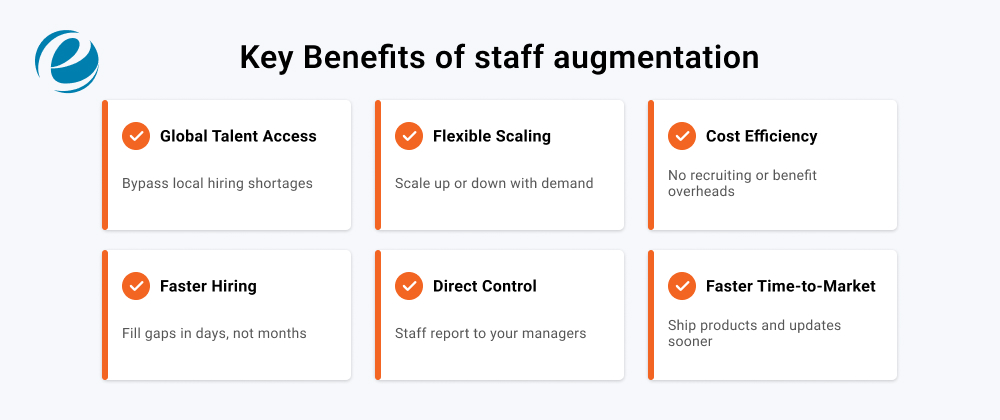
Staff augmentation allows your organisation to quickly add external professionals to your internal teams on a temporary basis.
- Access to Global Talent Pools: Staff augmentation services allows your organisation to bypass local hiring shortages, and instantly connect with top-tier professionals worldwide.
- Increased Scaling Flexibility: Your business can scale up rapidly, with IT staff augmentation when workloads spike and it scales down just as easily once major project milestones are completed successfully.
- Significant Cost Efficiency: You can drastically reduce overhead costs for short and mid-length contracts by avoiding the expensive expenses, which is linked to full-time recruiting, employee onboarding, benefits and long-term payroll commitments.
- Rapid Speed to Hire: Staff augmentation provides a rapid team extension that resolves critical skill gaps in days rather than months which keeps your high-priority projects moving forward without costly delays.
- Direct Project Control: Unlike fully outsourced projects, this form of team augmentation makes sure that external professionals work directly under your internal managers, which gives you the complete oversight over everyday tasks, and data security.
- Accelerated Time-to-Market: Adding specialised, project-ready experts directly to your workflow allows you to launch new software, products and updates much faster than relying solely on your existing team.
Challenges of Staff Augmentation (and How to Solve Them)
Your organisation will face key operational, cultural and security challenges when implementing staff augmentation, but you can overcome them with structured planning.
1. Communication Gaps and Time Zone Differences
Working with remote or external professionals often leads to delayed responses, language barriers and misaligned daily workflows.
- How to Solve It: Standardise collaboration tools like Slack, Jira or Microsoft Teams. Set daily stand-up meetings and define mandatory overlapping hours for real-time collaboration.
2. Slow Onboarding and Integration Friction
New temporary hires face delays in getting system credentials, understanding internal codebases, or by learning company processes which takes up your valuable project time.
- How to Solve It: Build a comprehensive digital onboarding kit with workflows, style guides, and pre-arranged system access. Assign an in-house mentor or buddy to help the augmented staff settle in faster.
3. Cultural Misfits and Team Silos
In-house employees may feel disconnected or resistant toward external contractors which causes a drop in collective productivity and morale.
- How to Solve It: Establish an open and welcoming environment by introducing augmented staff during their introductory meetings. Treat them as a true extension of your core team through joint workshops and team-building activities.
4. Security Risks and Data Privacy Concerns
Granting external network and database access to your temporary workers increases vulnerability to data breaches and leaks.
- How to Solve It: Require all augmented workers to sign strict Non-Disclosure Agreements (NDAs). You should also set up role-based access controls and monitor system activity regularly.
5. Inconsistent Work Quality and Accountability
Tracking your delivered goods and maintaining uniform quality standards becomes harder when managing a distributed or external workforce.
- How to Solve It: Define clear Key Performance Indicators (KPIs) and quality metrics from day one and also, conduct regular sprint reviews and provide constructive feedback early.
Staff Augmentation vs Outsourcing vs Managed Services vs In-House Hiring
Choosing between staff augmentation vs outsourcing vs managed services vs in-house hiring depends on who manages the day to day work, who owns the final outcome and how fast you need to launch.
| Dimension | Staff Augmentation | Project Outsourcing | Managed Services | In-House Hiring |
| What You Buy | Temporary skills and extra people | A finished project or defined scope | Ongoing service and results under an SLA | Permanent staff on payroll |
| Who Manages the Work | Your team / internal managers | The vendor / third-party provider | The service provider | Your internal team |
| Who Owns the Outcome | Your internal team | The external vendor (based on scope/SOW) | The service provider (based on SLA) | Your internal team |
| Speed to Start | Fast (days to weeks) | Medium (weeks) | Medium to slow | Slow (months) |
| Payment Structure | Hourly, time & materials or monthly retainer | Fixed price or milestones | Monthly subscription/retainer | Regular salary + benefits |
| Ideal Duration | Weeks to 12 months | Discrete project length | 12 months or longer (ongoing) | Permanent / Long-term |
| Best Suited For | Short-term skill gaps or adding extra capacity. | Delivering an entire project from start to finish. | Long-term, recurring operational needs (e.g., IT helpdesk, security). | Core, long-term business capabilities and IP creation. |
When to Choose Staff Augmentation
You should choose staff augmentation when you already have a tech team and a project manager but need additional resources or highly specialised expertise.
For ex. if you are working on an ecommerce app development dubai project, you might already have a designing team but may lack backend developers who know how to integrate local payment gateways; so instead of going through a months-long recruitment process you can use staff augmentation services to bring in experts immediately.
This team augmentation model is perfect when:
- You want to keep total control over the code quality, daily tasks, and workflows.
- You need to scale your team up or down quickly based on changing workloads.
- You want to hire web developers who will plug directly into your daily Slack, Jira, or Zoom meetings just like regular employees.
When Project Outsourcing Is the Better Fit
Project outsourcing is a better fit when you hand over an entire concept to an external vendor and let them handle the technical execution from start to finish.
If you are in a retail business with zero tech staff and you want to build an intelligent product recommendation engine, you should not just use ML model engineering services individually since you might not have an internal tech team to manage it. Project outsourcing allows you to give the requirements to a vendor and then they will bring their own project managers, developers and QA testers to deliver a completed project.
This project outsourcing works best when:
- You do not have an in-house project manager or tech lead to oversee daily developer or data science work
- You want the vendor to take on the risk of delivering the production ready system on time & on budget
- The project has a clearly defined scope, beginning and ending.
How Much Does Staff Augmentation Cost?
The cost of staff augmentation depends heavily on whether you choose Onshore talent (professionals living inside the UAE) or Offshore/Nearshore talent (professionals working remotely from nearby regions like Egypt, India, Jordan, or Eastern Europe).
When you use staff augmentation, agents usually bill in two ways: either an hourly rate (time & material) or a fixed monthly rate for the dedicated full-time employee. Either way, you pay a single all-inclusive rate, as the agency covers everything else, from recruitment and residency visas to health insurance and end-of-service gratuity included in the quoted rate of the offshore talent.
The table below breaks down what you can expect to pay per hour and per month based on the role and how the talent is positioned:
| Tech Role | Onshore Rate / Hour | Offshore Rate / Hour | Average Monthly Retainer (Offshore/Nearshore) |
| Full-Stack Developer | AED 90 – AED 180 | AED 73 – AED 176 | AED 11,700 – AED 28,200 |
| Frontend / Backend Dev | AED 75 – AED 160 | AED 66 – AED 150 | AED 10,600 – AED 24,000 |
| Mobile App Developer | AED 90 – AED 185 | AED 73 – AED 184 | AED 11,700 – AED 29,400 |
| DevOps / Cloud Engineer | AED 120 – AED 220 | AED 90 – AED 185 | AED 14,400 – AED 29,600 |
| QA / Tester | AED 60 – AED 120 | AED 55 – AED 110 | AED 8,800 – AED 17,600 |
Note: Monthly figures are based on 160 working hours per month and are rounded to the nearest AED 100. USD to AED conversions are fixed at the standard rate set by the Central Bank of the UAE, i.e., $1 = AED 3.6725.
Key Factors That Affect the Final Quote
- Visa and Legal Logistics: If you require the augmented staff to physically work out of your UAE office, the staffing agency must manage local labour compliance, or you must sponsor them, adding roughly 10%–15% in administrative or local partnership overhead, unless the agency has already built this into the quoted rate.
- Contract Length: Shorter sprints (1–3 months) carry higher markups of 50%–75%, whereas long-term retainers (6+ months) allow vendors to lower margins closer to 25%–40%.
How to Choose the Right Staff Augmentation Company
Choosing the right staff augmentation company in UAE requires a strategy that adapts fast-paced business environment and unique regulatory framework of the geographical location. To select the ideal partner, you must look further than their resumes and instead you should thouroughly evaluate their technical fit, cultural alignment, local talent acquisition speed and compliance frameworks.
- Define Your Core Objectives: Identify if your project requires quick scaling for a fast launch or a niche technical expertise for complex system updates, so you can search for providers whose staff augmentation services matches your specific operational scale such as FinTech, real estate or Healthcare.
- Verify Technical and Screening Vetting: You must consider looking for firms that use strict & thorough evaluation process, especially when you need specialised IT staff augmentation. Make sure their screening process includes, practical code reviews, technical interviews, by subject matter experts and verification of certifications.
- Demand Transparency in Candidate Selection: Proper team augmentation allows you to interview specific as well as named individuals. Reject providers that offer anonymised, or filtered profiles, or even reserve the right to swap candidates with equivalent resources without your input.
- Evaluate Local Onboarding Speed: A reputable UAE-based partner should rapidly deliver a qualified shortlist and complete onboarding process including local HR logistics, to protect your timeline.
- Check the Replacement and Expansion Policies: Make sure the agreement includes, flexible engagement terms and the vendor should provide a hassle-free replacement guarantee, if an augmented team member does not meet performance expectations.
LEGAL & CONTRACT CONSIDERATIONS
Operating a team extension in UAE means navigating strict labour laws, and corporate compliance requirements. When drafting your staff augmentation services agreements, pay close attention to the following frameworks:
|
Why Choose EmizenTech for Staff Augmentation?
Finding augmented developers is straightforward but finding ones who actually integrate into your team, hit the ground running and deliver consistently is a different matter entirely. With 12+ years of experience and successful placements across 40+ countries, EmizenTech provides staff augmentation services that go well beyond simply filling a seat with a 4.9 rating on clutch & 5 on Goodfirms.
Here’s what working with our team typically looks like:
- Vetted developers, engineers and architects across web, mobile, AI, and cloud matched to your existing stack and workflow
- Full capability in custom software development and cutting-edge AI development services for businesses requiring more than standard IT profiles
- Flexible team extension engagements that will scale your team up or down based on project demand, with no long-term lock-in forcing your hand
Whether you need a single specialist included within your product squad, or a broader IT staff augmentation arrangement across multiple functions, EmizenTech structures the engagement around your delivery timeline not theirs. The easiest way to explore fit is to book a 60-minute call with our technical head in the UAE, and walk through your requirements directly.
Conclusion
Talent shortages, tight delivery windows and the cost of permanent hiring don’t disappear, but staff augmentation gives you a practical way to work around all three simultaneously. Whether you need a short-term team extension, or a long-running embedded specialist, the model puts skilled people inside your workflow without the administrative weight of full employment. Get the engagement structure right and it’s one of the most efficient ways to scale a technical team in 2026.
FAQs
What is staff augmentation in simple words?
Staff augmentation is a hiring model where you bring in external professionals to work as part of your internal team, and under your direct management without taking them on as permanent employees through your own payroll.
How is staff augmentation different from outsourcing?
With staff augmentation you manage the individuals directly, and retain full control over daily tasks and output. With outsourcing, an external vendor manages the team and delivers a result independently with minimal oversight from you.
How much does staff augmentation cost?
Costs vary by role, seniority and region. Offshore and nearshore IT staff augmentation typically runs between AED 55 and AED 185 per hour, while onshore specialists in the UAE range from AED 60 to AED 220 per hour, depending on the role and skill set. Most agencies either quote with an hourly rate or a monthly retainer per person.
What are the risks of staff augmentation?
The main risks include communication gaps across time zones, slower onboarding without proper documentation and data security concerns when sharing codebases externally. A structured onboarding process, and clear IP agreements mitigate most of these effectively.
How quickly can augmented developers join my team?
Most staff augmentation services can place pre-vetted developers within five to ten business days. Specialist roles requiring niche frameworks or senior-level experience may take two to three weeks to source and confirm properly.
Who owns the code written by augmented staff?
You do, provided your contract explicitly states it and you need to always make sure that your agreement includes a clear IP assignment clause transferring full ownership of all work produced during the engagement to your business.
Can I convert augmented staff to full-time employees?
Yes, many team augmentation arrangements include a conversion clause. If an augmented professional proves to be an exceptional fit, you can negotiate, a buyout or direct hire agreement with the agency to bring them on permanently.

 +971-585876283
 hello@emizentech.ae
 emizentech