
 Emizentech
 Call
 hello@emizentech.ae


Key Takeaways
- What it is: An Arabic chatbot is software that chats with customers in Arabic on WhatsApp, your website or an app. The old kind sticks to fixed menus. The newer kind runs on a large language model, so people can just type what they want.
- The dialect problem: Hardly anyone writes formal Arabic. Customers switch between Gulf, Egyptian or Levantine dialects, Arabizi (Arabic in Latin letters and numbers, like “3ndkom”) and English, sometimes in one message. A bot trained only on formal Arabic will miss plenty of them.
- Build steps: Pick one goal, choose a channel, decide whether to build, buy or mix, choose an Arabic-capable model, prepare dialect-friendly data, design bilingual flows with RTL checks, connect your systems, test with native speakers, then launch and keep tweaking.
- Cost: A no-code platform starts around AED 200 a month (about $55). A basic bilingual bot runs AED 29,000 to 55,000, a production bot AED 73,000 to 165,000, and enterprise or self-hosted builds start at AED 165,000.
- Timeline: Platform setup takes days to two weeks. A basic bot needs 4 to 8 weeks, a production bot 2 to 4 months, and an enterprise build 4 to 8 months. Treat these as estimates, because dialect testing and compliance reviews almost always run longer.
A customer in Dubai opens WhatsApp and types, “3ndkom delivery el youm?” which means, “Do you have delivery today?” Nothing unusual about it. But the Arabic chatbot on the other end answers in stiff, newspaper-style Arabic or gives up with a “sorry, I didn’t understand.” The customer gets annoyed and immediately goes to a competitor. You won’t see that in any report, which is the annoying part.
It is not a rare case, as per the data from Statista most of the people aged 16 and above in the UAE use WhatsApp, and they write the way they talk. Gulf dialect, Arabizi, half a sentence in English, and a bot that only knows formal Arabic are going to miss a lot of them. To avoid this hassle, businesses need more than a basic chatbot; consider this blog as your guide to it. You will get all the necessary information on build steps, cost range, and the timeline.
What Is an Arabic Chatbot?
It is a software that interacts with customers in Arabic, usually on WhatsApp, website or an app. It answers questions, books appointments, captures leads the old one follows menus and scripts. The newer kind uses a large language model (LLM), the same type of technology behind ChatGPT, so people can just type whatever they want.
Rule-Based vs AI agent vs LLM-Powered Arabic Chatbots 
| Key Aspects | Rule-based | LLM-powered chatbot | AI agent |
| How it works | Fixed menus, keywords, scripted flows | Writes answers from your documents using an LLM | LLM plus tools that actually do things |
| Arabic dialects | Only what you script by hand | Good, if the model and prompts are right | Same, plus actions |
| Suitable for | Simple FAQs, button flows | Support and product questions | Order lookups, bookings, refunds, CRM updates |
| Main weakness | Falls apart on unexpected phrasing | Can make things up if it isn’t tied to your data | Needs tight permissions and a lot of testing |
A chatbot tells a customer your return policy. An agent checks the order, starts the return and updates your CRM. Most businesses should still begin with the chatbot, get the answers reliable, and only then think about an AI agent.
Why UAE and GCC Businesses Need an Arabic Chatbot in 2026
Arabic is the UAE’s official language, and plenty of Emiratis and Arab expats reach for it first when something matters: a complaint, a payment, a booking. An English-only bot quietly loses those people. You’ll never see it in your reports, because they just leave. The tools also got a lot better recently inception, Cerebras and MBZUAI released Jais 2 in December 2025, a 70-billion-parameter open-weight Arabic model.
TII followed with Falcon-H1 Arabic in January 2026, and in October 2026 it added Falcon-Emirati, a 7-billion-parameter model built specifically for Emirati Arabic. So Arabic AI that runs on UAE infrastructure is a realistic option now, not a research demo. Our LLM development services team works with models like these which makes the whole business operation seamless as the bot answers at 2 a.m., and on a Ramadan evening when your team is on off. That frees your people for the cases that actually need a human.
Why Building an Arabic Chatbot Is Harder Than an English One
Arabic looks like one language on paper, but nobody actually talks the way they write. Someone in Dubai might type a formal complaint in Modern Standard Arabic, then send a casual follow-up in Gulf dialect with a few English words dropped in halfway through. A bot has to keep up with all of that. The missing vowels and the right-to-left layout english chatbots have it easy by comparison.
Dialect Diversity
Modern Standard Arabic (MSA) is the language of newspapers and official letters. Almost nobody texts in it. Gulf, Emirati, Egyptian and Levantine speakers all have their own words for the same idea. Take one question, “I want to know where my order is”:
| Variant | Message | What to notice |
| MSA | أريد أن أعرف أين طلبي | Formal, reads like a letter |
| Gulf / Emirati | أبي أعرف وين طلبي | “أبي” = I want, “وين” = where |
| Egyptian | عايز أعرف طلبي فين | “عايز” and “فين” |
| Levantine | بدي أعرف وين طلبي | “بدي” = I want |
Same question, four different sentences. A bot that replies to the Gulf version in MSA feels like getting a legal notice in reply to a text message.
Arabizi (Franco-Arabic)
Lots of younger customers write Arabic in Latin letters and use numbers for sounds that don’t exist in English: 3 for ع, 7 for ح, 9 for ق. So “7abibi” means “my dear,” and “3ayez” is the Egyptian “I want.” Most chatbots were built around Arabic script and stumble here. Put Arabizi in your test set, and decide early whether the bot replies in Arabic script or just mirrors whatever the customer used.
Arabic-English Code-Switching
“Can you send the invoice عن طريق الإيميل؟” is a totally ordinary WhatsApp message in the UAE. The bot shouldn’t treat that as an error, and it shouldn’t force the whole reply into one language either. It just needs to follow along.
Morphology and Missing Diacritics
Arabic sticks prefixes and suffixes onto words, so a single word can hold a whole phrase. وبالكتاب means “and with the book.” On top of that, short vowels are usually left out when people write, so كتب could be “he wrote” or “books.” The bot has to work out which one from the sentence around it. That’s one reason plain keyword matching gives up so quickly.
Right-to-Left (RTL) UI Challenges
Arabic runs right to left, but numbers and English words run left to right. Mix them in one line and you can get scrambled order, flipped punctuation or chat bubbles that sit on the wrong side. Check order numbers, phone numbers and buttons on every channel you use. If the bot lives inside an app, your mobile app development team should build mirrored layouts from day one, not bolt them on at the end.
Cultural Context and Tone
Greetings carry weight. “السلام عليكم” or “حياك الله” sets a different mood from a flat “Hello.” Match the formality to your brand (a bank and a streetwear shop shouldn’t sound alike), and teach the bot about Ramadan working hours and Eid delivery dates. Nothing says “we didn’t think about you” like a promised delivery slot in the middle of Eid.
Key Features Every Business Arabic Chatbot Must Have
Plenty of chatbots claim Arabic support but most of them just run on a simple method of running it through a translator and call it a day. You can tell within two messages, and so can your customers.
Dialect and Language Switching
Nobody in Dubai texts the way a news anchor speaks. People write Gulf dialect, or formal Arabic, or Arabizi, which is Arabic typed in Latin letters and numbers (think “marhaba” or “3ayez”). Half the time they throw English words into the same sentence. A decent bot copes with all of it. If a vendor only demos formal Arabic, ask to test it with messy, real messages.
Answers From Your Own Content
This one matters more than anything else on the list. The bot should answer from your FAQs, product pages and policies, usually through something called RAG. Without it, the bot makes things up, confidently, and you find out when a customer complains. And when it genuinely doesn’t know? It should say so.
Human Handoff and Multi-Channel Reach
Bots get stuck that’s fine, as long as a real person can step in with the whole conversation in front of them. Nothing annoys a customer more than repeating their problem. Also, be where people already are. In the UAE that mostly means WhatsApp, then your website, then Instagram.
How to Build an Arabic Chatbot: Step-by-Step Process

Building an Arabic chatbot isn’t hard, but the order in which the development works matters. Decide what the bot is actually for, then pick your dialects, platform and training data. Get those wrong and no amount of testing will save it. Here is a step-by-step development guide for your better understanding.
Step 1: Define Goals and Use Cases
Pick one main job support, sales and lead capture, bookings, or an internal HR assistant. Just one. An internal bot that answers staff questions is closer to an AI copilot than a public chatbot, so it’s worth knowing which one you’re really building. Then read your last 50 customer conversations and write down the 10 to 20 questions that keep coming back. Those make up version one.
Step 2: Choose Your Channels
For most UAE businesses, WhatsApp is the place to start, as from July 1, 2025, Meta bills WhatsApp Business messages one at a time. You only pay for messages you send to customers, and only once they’ve been delivered. Anything a customer sends you is free, and so is a message that never arrives. What you’re charged depends on two things: the message category and the country code of the number you’re messaging. Each message sits in exactly one of five categories, so it never gets charged twice. Three of those cover template messages, which you can send whenever you like: Marketing for promotions, Utility for transactional or informational updates, and Authentication for identity checks.
Step 3: Pick the Right Approach (Build vs Buy vs Hybrid)
- Buy: a no-code platform with Arabic support. Quick and cheap, but you get less say over dialects, data and integrations.
- Build: a custom bot on an LLM, fed with your own data. Costs more, but you control the tone, the integrations and where the data sits.
- Hybrid: a platform for channels and the inbox, with a custom AI layer and integrations on top.
| Key Aspects | What you get | Estimated Cost in AED | Estimated Cost in USD | Estimated timeline |
| Platform subscription | No-code bot, templates, basic Arabic | From about 200 per month | From about $55 per month | Days to 2 weeks |
| Basic bilingual bot (built) | Website chat, Arabic and English, FAQs | 29,000 to 55,000 | $8,000 to 15,000 | 4 to 8 weeks |
| Production bot | Dialect handling, WhatsApp, CRM and booking integrations, human handoff | 73,000 to 165,000 | $20,000 to 45,000 | 2 to 4 months |
| Enterprise or self-hosted | In-country hosting, RAG, security reviews, many channels | 165,000+ | $45,000+ | 4 to 8 months |
It is important to note that prices are subject to change and could vary according to the features and integrations needed. Apart from that, the duration for development plays a significant role, which usually takes 4 to 8 weeks to go live for the basic bilingual bot. On the other hand a fully functional production bot might take 2 to 4 months because multiple factors, such as dialect testing, integrations and compliance reviews, take longer than anyone plans for. Businesses can effectively manage these numbers by onboarding an enterprise AI chatbot development company to do all the heavy lifting.
Step 4: Select an Arabic-Capable AI Model
The Arabic-native options come from the UAE itself. Jais 30B was trained on 126 billion Arabic tokens alongside 251 billion English tokens and 50 billion code tokens, its successor, Jais 2, has 70 billion parameters. TII’s Falcon-H1 Arabic and the Emirati-focused Falcon-Emirati are open options too. Global LLMs handle Arabic well, but they tend to slip into formal MSA unless you tell them which dialect to use.
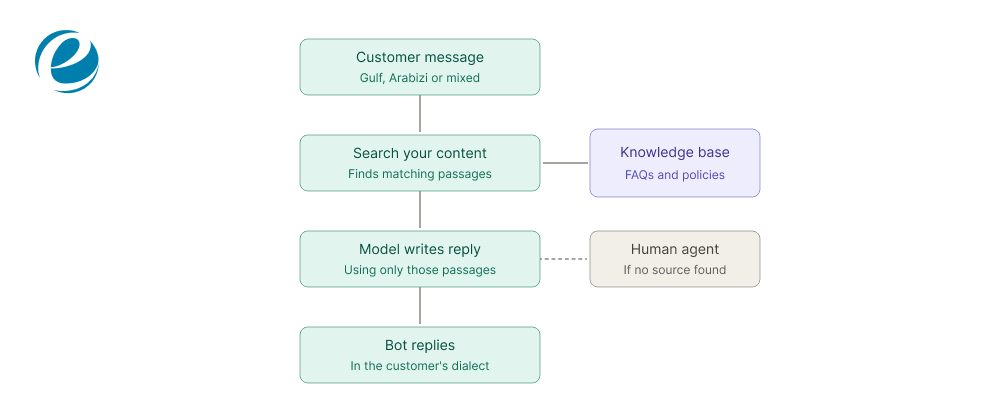
Whatever model you choose, ground it with RAG (retrieval-augmented generation). It sounds technical but the idea is simple: before answering, the bot looks up the relevant passages in your own documents and hands them to the model. So the reply comes from your prices and your policies, not from whatever the model half-remembers. It’s a core piece of generative AI development.
Step 5: Prepare Arabic Training Data and Knowledge Base
Write your FAQ answers the way customers ask the question, not the way a brochure would. If they say “وين” (where) which is informal arrabic instead of “أين,” which is (Modern Standard Arabic ) your knowledge base should say it too. Pull dialect samples from real chats (strip out names and numbers first). Then normalise the text so variants match: unify the alef forms (أ إ آ), remove decorative letter stretching, and treat Arabic-Indic and Western digits as the same number. If you need labelled examples of intent and dialect, data annotation services can do that.
Messy source material like PDFs, price sheets and old chat exports needs cleaning before any of this works, and that’s data engineering work. It’s the unglamorous part, and it decides a lot.
Step 6: Design Bilingual Conversation Flows and RTL UI
Detect the language of each message and reply in it. Offer a language switch. Keep a fallback for unclear messages (“Did you mean…?”), and make the route to a human easy to find. Pick one numeral style and stick with it. Then look at the mirrored layouts, buttons and quick replies on WhatsApp, mobile and desktop, because they rarely look the same on all three.
Step 7: Integrate With Business Systems
A bot that only chats is basically a fancy FAQ page businesses need more than that, such as pulling up an order, booking a slot, opening a ticket, and sending a payment link. The best way to do it is to integrate it with whatever your team already uses, such as a CRM, helpdesk, online store, booking tool or payment gateway. Looking up an order is low risk; changing or cancelling one is not, so add that later, once you analyse its functioning. Other than that, it is important to know how it handles the data. Where does the customer data end up? If the bot touches personal details, find out where they’re stored and which servers process them.
Step 8: Test With Native Speakers Across Dialects
Build a test set of 100 or more real messages. Mix in MSA, Gulf, Egyptian, Levantine, Arabizi, code-switching, typos and voice-note transcripts. Native speakers should score each reply on meaning, natural tone and safety, and a couple of them should actively try to break it with off-topic and risky questions.T
Step 9: Launch, Monitor, and Continuously Improve
Launch to a small group first. Watch unresolved questions, handoff rate and customer ratings, and read the failed chats every week. Update the knowledge base, and re-run your test set after any model or prompt change, since small tweaks can break things that worked. MLOps consulting keeps this routine manageable once volumes grow.
Best Tech Stack for Arabic Chatbot Development
You don’t have to be technical to follow this. But a rough idea about the tech stack will make you an active part of the development process. This will also help you question whoever builds it, and it’ll stop you overpaying.
Language Models and NLP
The model is the brain jais is an Arabic-focused model built in the UAE, and it tends to handle dialects more naturally. Global models like GPT or Claude are strong at reasoning and longer answers. Run two or three against a batch of your actual customer messages and see which one sounds right. Add Arabic NLP tools on top for spelling cleanup and intent detection, because Arabic spelling are sometimes inconsistent.
Channels, Backend and Integrations
Most UAE projects start with the WhatsApp Business API. Behind that sits a backend, usually Node.js or Python, connected to your CRM, booking system or payment tool. This is the important part, and also the part that makes the bot useful. A bot that can only chat is a toy one that checks an order status or books a slot actually saves you time.
Hosting and Data Residency
Where the data lives matters, especially under the UAE’s PDPL and any rules for your sector. Many businesses choose local or regional cloud hosting. Sort this out early moving later is slow and costs far more than people expect.
Arabic Chatbot Use Cases by Industry
The tech is the same everywhere, but what you do with it changes a lot from one business to the next. However there are the few industries where being the quickest paysoff in form higher customer retentation.
Retail and E-commerce
Shoppers ask the same things over and over: where’s my order, can I return this, is it in stock. A bot answers in seconds, at any hour. It really earns its keep during big sale periods like White Friday, when your support team is drowning. See AI in e-commerce.
Banking, Real Estate and Insurance
These industries get repetitive questions that are also high value. A bot can answer account queries, qualify property leads, explain policy terms and book viewings. Keep anything sensitive behind proper verification, though, and send the tricky cases to a human advisor.
Healthcare, Hospitality and Government Services
Clinics use bots for appointments and reminders. Hotels and restaurants use them for bookings and guest requests. Government services use them to explain procedures in plain Arabic, which people appreciate more than you’d think. In all three, tone counts. Polite and clear beats fast and clumsy.
Arabic Chatbot Compliance and Data Privacy in the UAE
The UAE’s Federal Decree-Law No. 45 of 2021 on personal data protection has been in force since 2 January 2022. It covers the personal data of people in the UAE, including when a foreign company handles it, and it needs consent or another lawful basis. DIFC (Dubai’s financial free zone)and (Abu Dhabi’s modern financial hub) ADGM have their own regimes, and health and banking data fall under separate laws.
People should be well aware of the fact that they’re talking to a bot. Get consent before you store personal details. Honour deletion requests, and don’t keep data longer than you need to. Get opt-in before sending WhatsApp marketing messages.
Common Mistakes to Avoid When Building an Arabic Chatbot
- Writing the whole knowledge base in formal MSA.
- Translating English flows word for word and calling it done.
- Ignoring Arabizi and code-switching.
- Judging a platform by its demo instead of your own messages.
- Skipping RTL checks on WhatsApp and mobile.
- Letting the bot answer without grounding it in your data.
- Hiding the human handoff.
- Forgetting that running costs don’t stop at launch.
Why Choose Emizentech to Build Your Arabic Chatbot
An Arabic chatbot touches a lot of different areas: language data, LLMs, integrations, security, and monitoring after launch. Emizentech covers chatbot and agent development, generative AI, data annotation and engineering, MLOps and system integrations in one place, so you aren’t juggling five vendors. As an artificial intelligence development company, we begin with how your customers really write and what systems you already have, then build in stages so you see something working early.
Final verdict
Arabic chatbot has to sound like your customers, not like a textbook, and definitely not like an English bot pushed through a translator. Most of the ones that fail do so for boring reasons. Nobody tested Gulf dialect or Arabizi. Nobody checked how the text looks right to left. The bot was never tied to the company’s own content, or the way to reach a human was buried three menus deep.
Start smaller than you think you need to one job, WhatsApp, and the 10 to 20 questions that come up every single week. Pick a model that handles Arabic properly, feed it your own answers, and get a few native speakers to try to break it before customers do. After launch, read the chats where it got things wrong. That’s where the real improvements come from. Want help scoping yours? Talk to our team about your use case.
FAQs
What is an Arabic chatbot?
Software that chats with customers in Arabic on WhatsApp, websites or apps, answering questions, booking appointments and capturing leads.
How do I build a chatbot in Arabic?
Define one use case, choose a channel, pick a build approach and an Arabic-capable model, prepare dialect-aware data, design bilingual flows, connect your systems, test with native speakers, then monitor and improve.
Can AI chatbots understand Arabic dialects?
Yes, modern LLMs can, though quality varies. Many default to formal Arabic unless you tell them which dialect to use, so test with real Gulf, Egyptian and Levantine messages.
What is the best Arabic chatbot platform for businesses?
There isn’t one best option. Pick based on your dialects, channels, integrations and data hosting needs, and try each platform on your own customer messages.
How much does an Arabic chatbot cost in the UAE?
Rough ranges run from about AED 200 a month for a platform to AED 165,000 or more for an enterprise build. It depends heavily on scope.
Can an Arabic chatbot work on WhatsApp?
Yes, through the WhatsApp Business Platform. Replies within 24 hours of a customer message are free, while template messages you send first are charged.
Can a chatbot understand Arabizi (Franco-Arabic)?
Some can, but support is uneven. Add examples like “7abibi” and “3ayez” to your test set before you commit to anything.
Is Modern Standard Arabic enough for a UAE chatbot?
Usually not. It’s fine for formal or government use, but customers tend to write in Gulf dialect, Arabizi, or a mix of Arabic and English.
How long does it take to build an Arabic AI chatbot?
Around 4 to 8 weeks for a basic bot and 2 to 4 months for a production bot with integrations. Those are estimates.
Is my customer data safe with an Arabic chatbot in the UAE?
It can be, with consent, minimal retention, access controls and UAE-based hosting where needed. Check your setup with legal counsel.

 +971-585876283
 hello@emizentech.ae
 emizentech